About the book
Do you want to be happier and healthier? Most of us do, but happiness can be elusive: it’s not obvious where to find it and we don’t learn about it at school. This book, possibly the first of its kind, aims to provide you with a complete but compact life guide to happiness and health. It contains all you need to know to make your first steps along a path of increased happiness and health and acts as a guide for your subsequent journey.
It also serves as a map of the subject, and signposts further resources to help you as you progress.
The author has extracted knowledge from many different disciplines (Evolutionary Science, Buddhism, Mindfulness, Psychology, Psychotherapy, Neuroscience, Medical Research, Health, Fitness and Nutrition). He has then condensed, restructured and systematically combined that material into one book. If you don’t have the time to read the many other good books out there, then this “one-stop shop” might be a good place for you to start.
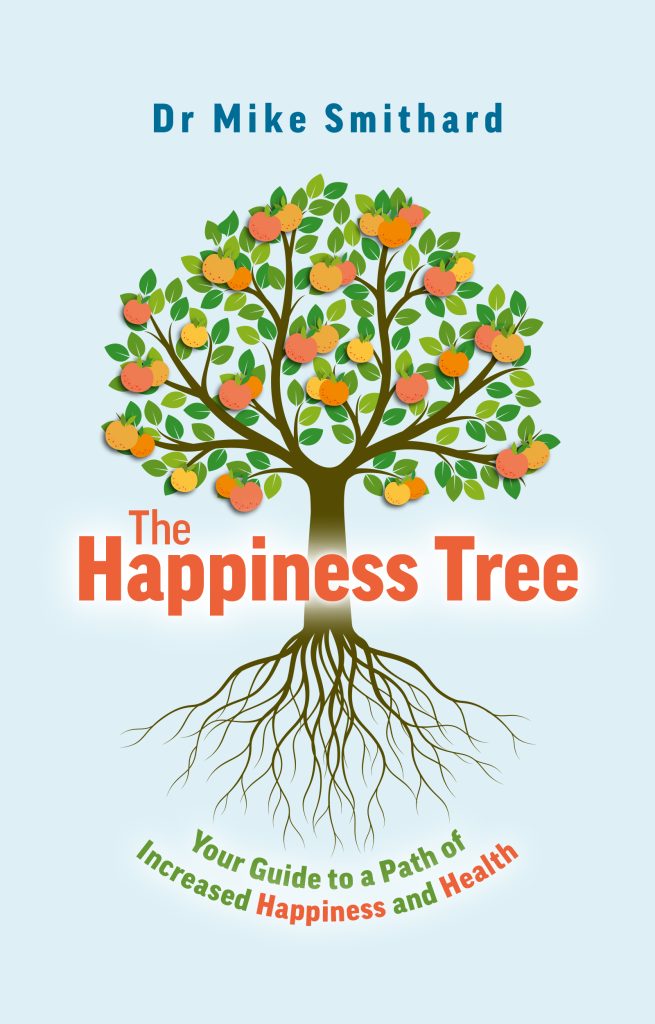
The author has made a particular effort to make this book easy to understand. He has used models, pictures and analogies. He has also structured the material in a very carefully chosen way. Each topic is symbolised by the root or branch of a tree. (To preview this concept before buying the book, click on the Look Inside button at the top of the book cover image on the left of the screen, and then scroll to pages 3-6 which show the Happiness Tree Model )
From this book, you can learn about all of the many different factors that affect your happiness and your health.
They are not all obvious, some are surprising. From the Happiness Cup Model, you will more easily understand how all of these positive and negative factors combine to determine your current level of happiness. This will help you to find the particular areas that you want to focus on. Then you will learn various techniques that will help you implement changes (for example meditation, positive thinking, relationships, compassion, lifestyle, exercise, healthy diet, relaxation, stress reduction, resilience and more). In this way, the book equips you with a toolbox of knowledge and skills that enable you to gradually develop a happier, healthier lifestyle.
Because we are all different, this book does not recommend one single solution for everyone. Instead, it shows you how to review your life against the bigger picture presented, and then customise a plan to suit your individual needs.
You will also learn here that our minds and bodies are not as rigidly fixed by our genes as previously thought. This is very encouraging news; it means there’s plenty of scope for improvement.
Does this book really achieve its ambitious aim? You may want to look at the first reviews posted. Click Here
This book attempts to start to bridge the current gap in our education. The tree model has been specifically structured with this in mind. Each of the roots and branches can become one module of an educational course. The modules all fit together seamlessly to deliver the whole picture like the pieces of a jigsaw puzzle. The material may be of interest to teachers, counsellors, and psychotherapists, as well as to universities and organisations involved in teaching and promoting happiness and health.
The Mind State Model (pages 145 onwards) is a novel, exploratory look at the way our mind shifts its focus of attention between engaged (Mindful) and disengaged (Wandering) states. It also represents how the mind moves from the real world to the imaginary one and back to create solutions to problems. It has the potential for considerable extension and may be of interest to psychologists.